
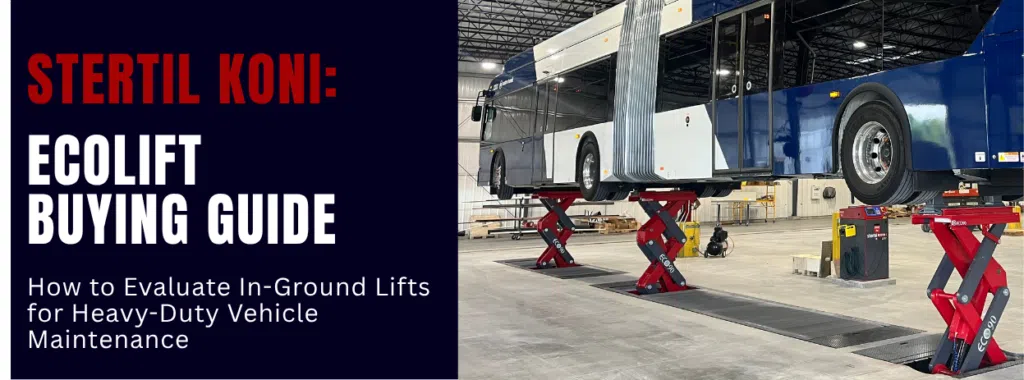
Stertil Koni: ECOLIFT Buying Guide
Investing in a heavy-duty vehicle lift isn’t just about capacity or features—it’s about how your shop operates today and how it will evolve over time.
In-ground systems like the EcoLift offer a fundamentally different approach compared to mobile columns or above-ground lifts. They can improve workflow, safety, and long-term flexibility—but they also require more planning upfront.
This guide is designed to help you evaluate whether an in-ground system—and specifically the EcoLift—is the right fit for your facility.
Table of Contents
What Is the EcoLift?
The Stertil-Koni EcoLift is an in-ground, axle-engaging scissor lift designed for heavy-duty vehicles such as buses, trucks, and municipal fleet vehicles.
Originally introduced in the late 2000s, the system is now in its seventh generation, with continuous improvements to structural components, control systems, and corrosion resistance.
Unlike traditional in-ground piston lifts, the EcoLift uses a shallow, wide-pit scissor design, allowing for:
- Wheel-free access to vehicles
- Greater flexibility across different vehicle lengths
- Installation in sites where deep excavation isn’t feasible
Key Buying Considerations
Before evaluating specific features, it’s critical to understand the broader factors that should guide your decision.
1. Facility Constraints
Your building conditions often determine what’s possible. The EcoLift’s shallow pit design (approximately 34 inches) can make it viable in locations where traditional deep lifts are not.
Key factors include:
- Soil conditions and bedrock
- Groundwater or high water table
- Existing slab condition (for retrofits)
- Ceiling height and bay layout
2. Your Vehicle Fleet
Your lift needs to accommodate not just your current fleet—but future vehicles as well. During planning, precise measurements are critical, “Close is good enough… that’s just not the case with these lifts. We build these things very much to spec.”
Consider:
- Maximum and minimum wheelbase
- Vehicle length variability
- Weight ranges (e.g., 60,000–120,000 lbs)’
3. Type of Work Performed
Different lift systems support different workflows. If your shop primarily handles quick-service or tire work, other lift types may be more appropriate.
EcoLift is particularly well-suited for:
- Brake and suspension work
- Wheel-free service
- Full undercarriage access
4. Installation Complexity & Timeline
Installing an in-ground lift is a construction project, not just equipment delivery.
Typical timeline: ~6 weeks (mostly driven by concrete curing requirements)
Typical process includes:
- Excavation
- Concrete vault construction (“three-pour” process: footer, walls, slab)
- Installation of conduit systems (hydraulic, electrical, air)
- Final placement and testing
5. Long-Term Flexibility
One of the most overlooked considerations is what happens if your facility changes. This can protect your investment over the long term. Unlike most in-ground systems, the EcoLift is designed as a bolt-in system, meaning it can be:
- Removed
- Relocated
- Reinstalled in a new facility
What Makes EcoLift Different
EcoLift has remained a leading in-ground lift solution because it was designed around real-world shop challenges—not just lifting capacity. From difficult site conditions and mixed fleets to workflow efficiency and long-term durability, the system is built to solve practical problems that heavy-duty facilities deal with every day. Simply put, Ecolift is built to keep your shop’s work moving efficiently.
Rather than focusing on features alone, it’s more useful to understand how specific design choices translate into operational benefits over the life of the system.
Ultra-Shallow Pit Design
- Requires less excavation
- Works in challenging environments (bedrock, high water table)
- Reduces construction complexity
Continuous Recess System
- Lift remains flush with the floor throughout travel
- Allows positioning anywhere along the vehicle
- Improves flexibility for mixed fleets
Low-Clearance Compatibility
- Minimizes risk of contact with low-profile vehicles
- Ideal for transit buses and specialty vehicles
Advanced Wheelbase Positioning (AWBP)
- Programmable positioning for fixed fleets
- Reduces setup time for repeat vehicles
- Most valuable in standardized fleet environments (e.g., school districts)
Galvanized Components
- Protects against corrosion
- Extends lifespan in harsh shop conditions
The Role of Site Planning & Consultation
A successful EcoLift installation starts well before construction.
A proper site evaluation typically includes:
Fleet Measurement
- Documenting shortest and longest wheelbases
- Ensuring lift travel range matches real-world needs
Bay Layout Analysis
- Door locations and tail swing clearance
- Technician workspace
- Overhead obstructions (lighting, reels, etc.)
Infrastructure Review
- Existing concrete condition
- Underground utilities or drainage conflicts
Control Console Placement
- Accessibility for technicians
- Proximity to power and air sources
Groundwater Assessment
- Identifying potential water intrusion risks
- Planning drainage or pump systems if needed
This consultative process is often what separates a smooth installation from costly issues later.
Installation & Maintenance Considerations
Equipment & Logistics
Installing the system requires specialized equipment such as telehandlers or heavy forklifts to place components accurately.
Moisture Management
Keeping the pit dry is essential for long-term performance. Common solutions include:
- Floor drains
- Sump systems
- Pneumatic pit pumps (especially for harsher environments)
Testing & Safety
Before handoff, systems undergo:
- Load testing
- Functional testing
- Safety lock verification
When EcoLift Is the Right Choice
EcoLift is typically a strong fit for:
- Municipal and government fleets
- Transit authorities
- School bus maintenance facilities
- Shops performing frequent wheel-free service
- Facilities with site constraints limiting deep excavation
- Long-term facilities planning for flexibility or relocation
EcoLift may not be ideal if:
- You need a low upfront investment
- Your shop primarily services light-duty vehicles
- You require maximum portability (mobile columns may be better)
- Your workflow is focused on quick service rather than deep maintenance
Common Questions
- How long does installation take? The entire process, from excavation to turning the lift over to the customer, typically takes about six weeks, accounting for necessary concrete cure times. Exact timelines depend on site conditions, concrete cure times, facility access, and project complexity.
- Can the EcoLift be moved? Yes. Unlike most inground lifts, the Eco Lift is a “bolt-in” design. It can be unbolted and relocated to a new facility if a customer moves or upgrades their building.
- How is water kept out of the pit? Pits can be equipped with natural drains or pneumatic pit pumps. SLE recommends pneumatic waste oil pumps for their robustness in nasty conditions.
- What is Advanced Wheelbase Positioning (AWBP)? AWBP is an optional feature that allows technicians to pre-program lift positions for specific vehicles. This can reduce setup time in facilities servicing the same fleet vehicles repeatedly, such as school districts or transit operations.