
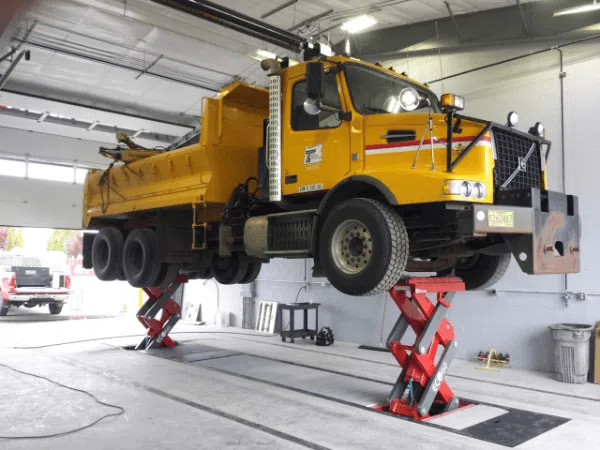
Why Work with SLE Technologies, Inc.?
SLE Technologies, Inc. doesn’t just sell lifts.
We engineer solutions.
Our customers benefit from:
✔ Site evaluations
✔ Capacity consulting
✔ Certified installation
✔ ALI inspections
✔ Ongoing service programs
✔ Warranty compliance
We help shops avoid expensive mistakes before they happen.
Frequently Asked Questions
What concrete thickness does SLE Technologies, Inc. recommend for a 2-post or 4-post lift?
SLE Technologies, Inc. customers typically require properly engineered concrete foundations to ensure long-term safety and performance.
SLE Technologies, Inc. recommends:
- Passenger & light-duty lifts:
Minimum 4 inches of 3500 PSI concrete - Heavy-duty lifts (16,000+ lbs):
6–8 inches with rebar or fiber reinforcement
High-capacity lifts concentrate thousands of pounds at anchor points. Improper slabs are one of the leading causes of lift failure.
Before installation, SLE Technologies, Inc. performs site evaluations to verify slab depth, condition, and compliance with manufacturer requirements.
What’s the difference between 2-post and 4-post lifts?
SLE Technologies, Inc. helps customers choose based on workflow, not just budget.
2-Post Lifts
Frame-contact lifting
Maximum undercar access
Best for service & repair
Requires anchoring
4-Post Lifts
Drive-on platforms
Higher stability
Ideal for storage & alignments
Optional rolling jacks
If your priority is productivity, SLE Technologies, Inc. usually recommends 2-post.
If your priority is stability or storage, SLE Technologies, Inc. often recommends 4-post.
What bay size does SLE Technologies, Inc. recommend?
SLE Technologies, Inc. suggests planning beyond “bare minimum.”
Minimum working space:
- 12 ft wide x 24 ft deep
Optimal service bay:
- 14–16 ft wide x 26–30 ft deep
This allows safe door opening, tool movement, and technician clearance.
Overhead obstructions should always be mapped before installation.
Do lifts require special electrical service?
Typical power:
- 220V single-phase (most common)
- 110V (limited residential models)
- 3-phase (industrial systems)
Many lifts require:
- Dedicated circuit
- Correct breaker sizing
- Licensed electrician
Electrical mismatches shorten motor life and create safety risks.
What maintenance does SLE Technologies, Inc. recommend?
SLE Technologies, Inc. customers follow preventative maintenance programs.
Routine inspections include:
- Cables/chains
- Safety locks
- Hydraulic systems
- Anchors
- Wear components
Can a lift be installed outdoors?
SLE Technologies, Inc. does not recommend outdoor installations.
Most manufacturers require indoor, enclosed environments.
Outdoor exposure causes:
- Corrosion
- Electrical failures
- Seal degradation
- Warranty voidance
If outdoor use is unavoidable, SLE Technologies, Inc. works directly with manufacturers to engineer approved solutions.
Do I need an air compressor?
Most SLE Technologies, Inc.-installed lifts are electric-over-hydraulic.
No compressor required for daily operation.
Exceptions:
- Bridge jacks
- Rolling jacks
- Some assist cylinders
These require shop air.
How tall should my ceiling be?
SLE Technologies, Inc. customers typically underestimate overhead clearance.
SLE Technologies, Inc. suggests:
- Most 2-post lifts: 11–12 ft minimum
- Tall vehicles / trucks: 12.5–14+ ft
- 4-post lifts: Similar or slightly less
Additionally, add 24 inches to account for safely standing the lift upright during installation.
Always consider lighting, ductwork, garage door tracks, and fire suppression systems when measuring usable height.
Do lifts have to be anchored?
SLE Technologies, Inc. follows ALI and manufacturer standards.
- 2-post lifts: Always anchored (mandatory)
- 4-post lifts:
May be freestanding, but anchoring is required for:- Alignment work
- High-cycle commercial use
- Heavy vehicles
- Alignment work
Improper anchoring voids warranties and increases liability.
Can I install a lift myself?
Installation involves:
- Precision leveling
- Torque-controlled anchoring
- Electrical compliance
- Safety system calibration
- Load testing
Improper installation is the #1 cause of lift-related incidents.
SLE Technologies, Inc.-certified installers ensure compliance, warranty protection, and long-term reliability.
What vehicles can different lifts handle?
SLE Technologies, Inc. matches lifts to real-world vehicle usage—not just listed weights.
2-Post Lifts
Cars, SUVs, vans, light trucks
Capacities: 9K, 10K, 12K, 16K+
4-Post Lifts
Storage
Fleet vehicles
SUVs & pickups
Heavy-Duty Systems
Buses
Box trucks
Semis
Municipal fleets
These require engineered foundations and custom layouts.
Are automotive lifts safe?
Yes—when installed and maintained properly.
SLE Technologies, Inc. installs and services ALI-certified equipment only.
Key safety systems:
- Mechanical locks
- Flow restrictors
- Redundant lifting systems
- Overload protection
Training and proper usage are equally important.
What lift capacity does SLE Technologies, Inc. recommend?
This is where SLE Technologies, Inc.’s consulting expertise matters most.
Industry best practice:
Choose 25–30% more capacity than your heaviest vehicle.
This accounts for:
- Uneven weight distribution
- Dynamic loading
- Long-term wear
- Accessory weight
Example:
If your heaviest truck is 9,000 lbs → SLE Technologies, Inc. recommends a 12,000 lb lift.
Undersizing is false economy.
Can a vehicle stay on the lift long-term?
Yes—if safety locks are fully engaged.
SLE Technologies, Inc. teaches operators to never rely on hydraulics alone.
Always:
- Lower onto locks
- Verify engagement
- Remove pressure
This ensures safe long-term storage.